Paris has long been one of Europe’s most recognizable destinations, attracting travelers with its historic streets, famous monuments, world-class museums, elegant neighborhoods, gardens, cafés, and distinctive cultural atmosphere. For someone visiting the French capital for the first time, the city can feel exciting and slightly overwhelming because there is so much to see.
A successful Paris trip does not require visiting every famous attraction. The city is best experienced by combining major landmarks with relaxed walks, local food, historic neighborhoods, and time beside the Seine. Paris currently has more than 2,000 monuments and hundreds of museums, so even returning visitors can continue discovering something new.
This guide covers the essential information first-time visitors need, including major attractions, neighborhoods, transportation, food, planning advice, and practical ways to make a Paris vacation more enjoyable.
⚡ Key Takeaways at a Glance
- Museum Pass Value: While the Paris Museum Pass covers admission to over 50 monuments and museums (including the Louvre, Musée d’Orsay, and Arc de Triomphe), pass holders must still reserve mandatory timed-entry slots online at major sites like the Louvre Official Hours & Admission, and all visitors must pass through standard security screening queues.
- Always Say "Bonjour": Always greet shopkeepers and waiters with a polite "Bonjour" when entering any establishment.
- Navigo Easy: Load current Metro-Train-RER tickets for metro, train and RER journeys. Bus and tram journeys use a separate Bus-Tram ticket. Check the latest fare and airport-ticket rules before travel via Île-de-France Mobilités.
- Picnic Along the Seine: Grab fresh baguettes, regional cheeses, and fruit from a local boulangerie for a scenic sunset riverside dinner.
When to Visit Paris
Paris can be visited throughout the year, and each season provides a different atmosphere. Spring is popular for its mild conditions and gardens, while summer offers long daylight hours and a lively atmosphere across the city. Autumn brings cooler temperatures and changing colors, while winter can provide a quieter experience around many attractions.

The ideal season depends on your priorities. Travelers who enjoy walking for several hours each day may prefer the milder temperatures of spring or autumn. Those who want longer evenings may enjoy summer, although popular attractions can become particularly busy.
Regardless of the season, checking the opening hours and reservation requirements for major attractions before traveling is worthwhile. Some museums and monuments can have specific entry arrangements, and advance planning can save considerable time.
How Long Should You Stay in Paris
A first visit of three to five days can provide a useful introduction to the city. Three days allow travelers to see several major attractions, while four or five days provide more flexibility for neighborhoods, museums, gardens, shopping, and relaxed exploration.
If you have only a weekend, concentrate on attractions that are geographically close to one another. The official Paris tourism office recommends organizing sightseeing by district so that visitors spend less time crossing the city and more time enjoying the attractions.
Longer stays can include day trips outside central Paris, with Versailles being one of the most popular options.
Eiffel Tower
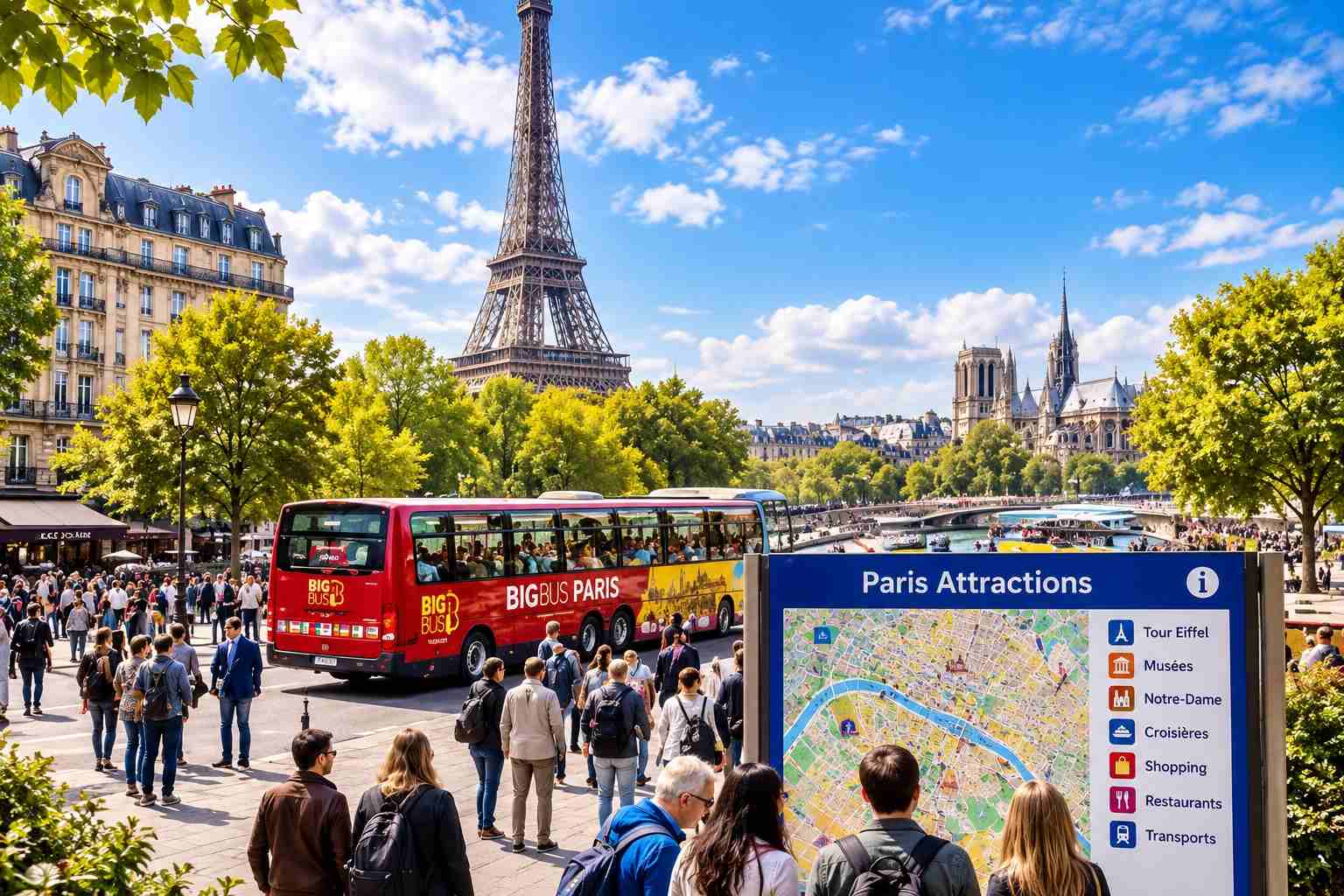
The Eiffel Tower is one of the defining symbols of Paris and is an obvious choice for a first visit. The structure provides different experiences depending on how you choose to visit it, including views from elevated levels and perspectives from the surrounding streets and gardens.
The area around the tower is also worth exploring. Champ de Mars provides an open space for views of the monument, while Trocadéro offers another popular viewpoint across the Seine.
For a first-time traveler, visiting the Eiffel Tower during the day and seeing it again after sunset can provide two very different experiences. If you plan to go inside, check official ticket availability before your trip rather than assuming you can always purchase the preferred entry time on arrival.
The Louvre Museum

The Louvre is one of the world’s best-known museums and contains an enormous collection covering centuries of art and civilization. Its scale means that attempting to see everything in a single visit is unrealistic.
First-time visitors should choose a few sections or individual works that interest them most. This makes the experience less tiring and allows more time to appreciate the exhibits.
The area surrounding the Louvre is also excellent for walking. From the museum, visitors can explore the Tuileries Garden, continue toward Place de la Concorde, or walk in the direction of the Seine.
Notre-Dame Cathedral
Notre-Dame is one of Paris’s most important historic landmarks. Located on Île de la Cité, the cathedral has played a central role in the city’s architectural and cultural history.
Visitors can combine a visit to Notre-Dame with nearby attractions such as Sainte-Chapelle and the Conciergerie. The official Paris tourism office currently identifies Notre-Dame and Sainte-Chapelle among the city’s major attractions for first-time visitors.
The surrounding area is also ideal for a walking tour because historic streets, bridges, river views, and other landmarks are located nearby.
Montmartre and Sacré-Cœur

Montmartre offers a very different atmosphere from the grand monuments of central Paris. The neighborhood is known for its artistic history, narrow streets, cafés, small squares, and hillside setting.
At the top of the hill stands the Sacré-Cœur Basilica, which provides broad views across Paris. The official tourism office lists Sacré-Cœur among the three most popular monuments for first-time visitors, alongside the Eiffel Tower and Notre-Dame.
Allow enough time to walk around the neighborhood rather than visiting only the basilica. The surrounding streets reveal a quieter and more intimate side of Paris.
The Champs-Élysées and Arc de Triomphe
The Champs-Élysées is one of Paris’s most famous avenues and connects the area around Place de la Concorde with the Arc de Triomphe.
The avenue is lined with shops, restaurants, and major buildings, while the Arc de Triomphe stands at its western end. The monument also provides an elevated perspective over the city’s avenues for visitors who choose to go inside.
This area works particularly well as part of a longer walking route that includes the Champs-Élysées, Arc de Triomphe, and nearby neighborhoods.
The Seine River

The Seine is more than a geographical feature running through Paris. It is one of the best ways to understand the layout and history of the city.
Walking along the river allows visitors to see landmarks from different perspectives while crossing historic bridges. A boat cruise provides another way to experience Paris, with major monuments appearing from the water.
The official tourism office recommends Seine cruises as a way to appreciate landmarks such as Notre-Dame, the Louvre, and the Eiffel Tower from a different architectural perspective.
Explore Parisian Neighborhoods
Paris is divided into twenty administrative districts known as arrondissements. Each has its own atmosphere, and exploring neighborhoods can make a trip much more interesting than moving only between major attractions.
Le Marais is known for historic streets, boutiques, cafés, and cultural attractions. The Latin Quarter has a long academic and intellectual history, while Saint-Germain-des-Prés is associated with cafés, galleries, and elegant streets.
Montmartre provides a hillside atmosphere, while the Canal Saint-Martin area offers a more relaxed urban environment. Choosing a few neighborhoods that match your interests can help you experience Paris beyond its most photographed landmarks.
Getting Around Paris
Public transportation is one of the most practical ways to explore the city. Paris has an extensive network of metro lines, buses, RER trains, trams, and other services. The official tourism office describes the network as one of the densest public transport systems in the world.
The metro is particularly useful for longer journeys between neighborhoods. As of 2026, the Paris metro has 16 lines and more than 300 stations, making it possible to reach most major areas efficiently.
Walking should also be part of your plan. Some of the most enjoyable Paris experiences happen between attractions, when you discover small streets, bakeries, courtyards, bookshops, and local cafés.
For transportation tickets, the current Metro-Train-RER single ticket is listed at €2.55 at full price by Île-de-France Mobilités. Bus and tram journeys use a separate ticket category.
Travelers who expect to use public transportation frequently can compare individual tickets with available travel passes before deciding what works best for their itinerary.
Getting From the Airport to Paris
Many international visitors arrive through Charles de Gaulle Airport, while Orly Airport is another important gateway.
Paris has rail and public transportation connections from its airports, but the best option depends on your arrival airport, accommodation location, luggage, and arrival time. The official tourism office provides current guidance covering airport transfers, trains, buses, and other transportation choices.
It is a good idea to determine your route before arriving, especially if you land late at night or are carrying several pieces of luggage.
What to Eat in Paris
Food is an important part of the Paris experience. Visitors can explore traditional French dishes, pastries, breads, cheeses, desserts, and regional specialties throughout the city.
Start with simple experiences such as a fresh croissant from a local bakery or a baguette purchased from a neighborhood boulangerie. Traditional cafés can provide opportunities to enjoy breakfast, lunch, or a drink while watching everyday Parisian life.
Markets are another excellent way to discover French food culture. Depending on the neighborhood and day, you may find fresh produce, cheese, bread, seafood, prepared foods, and other local products.
You do not need to eat at expensive restaurants every day to experience French cuisine. Mixing casual meals with one or two special dining experiences can help keep a trip enjoyable and manageable.
Where to Stay in Paris
Choosing accommodation near convenient transportation can make a major difference. Staying in a central neighborhood can reduce travel time, but properties farther from the main tourist areas may sometimes provide different price options.
For first-time visitors, consider the location of a hotel or apartment in relation to metro stations, restaurants, grocery stores, and major attractions. A beautiful property that requires long journeys every day may be less convenient than a simpler place with excellent transportation access.
It is also worth checking the neighborhood during both daytime and evening hours before making a final booking.
A Simple Four-Day Paris Itinerary
A four-day itinerary can provide a comfortable introduction without trying to see everything.
On the first day, explore the Eiffel Tower, Trocadéro, Champ de Mars, and nearby Seine area. Spend the evening walking beside the river or exploring a nearby neighborhood.
On the second day, dedicate several hours to the Louvre and then continue through the Tuileries Garden toward the Seine. You can finish the day around the historic center and Île de la Cité.
On the third day, explore Notre-Dame, Sainte-Chapelle, the Latin Quarter, and Le Marais. Keep the schedule flexible enough for cafés, shopping, and spontaneous discoveries.
On the fourth day, visit Montmartre and Sacré-Cœur before exploring another neighborhood that interests you. If you prefer a day trip, you could instead consider Versailles.
This itinerary is only a framework. Paris is easier to enjoy when there is some free time between major attractions.
Practical Tips for First-Time Visitors
Comfortable shoes are extremely useful because walking is one of the best ways to experience Paris. Keep important belongings secure in crowded tourist areas and public transportation, particularly around major attractions.
Learn a few basic French expressions before your trip. Simple greetings and polite phrases can make everyday interactions more pleasant.
Avoid planning too many major attractions on the same day. Museums and historic monuments can be tiring, and rushing from one side of the city to another can reduce the enjoyment of the trip.
Also remember that Paris is a living city rather than a museum. Residents work, commute, shop, study, and live alongside visitors. Being respectful of local spaces, following rules at monuments, and keeping noise levels reasonable can make the experience better for everyone.
Making the Most of Your First Paris Trip
The most memorable Paris experiences are not always the ones found on a checklist. A morning walk along the Seine, an afternoon spent in a quiet garden, a pastry from a neighborhood bakery, or an evening view from a historic street can become just as meaningful as visiting a famous monument.
The key is to balance sightseeing with exploration. Choose several major attractions that genuinely interest you, group nearby places together, and leave time to discover the city without a strict schedule.
Paris has an enormous cultural heritage, and the official tourism office currently highlights dozens of major sights, museums, neighborhoods, walks, and viewpoints for visitors.
Conclusion
Paris offers first-time visitors an extraordinary combination of history, art, architecture, food, fashion, gardens, and everyday urban life. The Eiffel Tower, Louvre, Notre-Dame, Montmartre, Sacré-Cœur, Champs-Élysées, and Seine provide an excellent introduction, but the city’s neighborhoods and quieter streets reveal another side of the French capital.
Good planning can make the difference between a rushed sightseeing trip and a comfortable holiday. Choose accommodation with convenient transportation, organize attractions by area, allow time for walking, and avoid filling every hour with scheduled activities.
Most importantly, give yourself permission to slow down. Paris is a city that rewards curiosity and patience. Once you look beyond the famous landmarks and begin exploring its streets, cafés, markets, gardens, and neighborhoods, the city becomes much more than a collection of tourist attractions. It becomes an experience that can stay with you long after the journey home.
💡 Paris Transit Tip: Download the official Île-de-France Mobilités app to check real-time transit schedules and eligible digital ticket options, noting that purchase rules and physical validation requirements vary by ticket product.
Related City Guides: Planning to combine Paris with other iconic European capitals? Compare your itinerary with our breakdown of 15 amazing things to do in London (accessible in just 2 hours via Eurostar). For tips on choosing safe, central Parisian neighborhoods, read our advice on how to choose the right hotel for your next trip.
Official Tourism & Transit Resources: For verified monument ticket booking, visit the Paris Convention and Visitors Bureau (Paris Je T’aime) and inspect live metro lines on RATP Official Paris Transit.
Frequently Asked Questions
How many days do you need for a first visit to Paris?
Four to five days provide the perfect duration to explore iconic landmarks like the Eiffel Tower and Louvre while enjoying quiet strolls in Le Marais.
What is the cheapest way to get around Paris?
The Paris Métro and RER network is the fastest and most affordable option. Navigo Easy passes or contactless single tickets offer effortless travel between zones.